Whatever happened to the Islamic empire? When Muslims were at the forefront of science, politics, law, medicine, philosophy, and the arts?
"The decline of the Islamic civilization is a great historical wound to Muslims. For a whole millennium their civilization had dominated most parts of the world. During that time, Islamic civilization was the entity that - due to its high degree of development - was the most expansive throughout the world."
Farabi, Ibn Sina, Ibn Rushd, Ghazali - what happened? And what happened to Muslims today to make them think that music, art, thinking for yourself, and debate are haram? All of these things have made Islamic civilization great. Muslims back then did not think every single thing was wrong, or that God does not love beauty. What is wrong with jazz? What is wrong with Rembrandt? Why are these unIslamic?!
"In those earlier times, a visitor from Mars might have supposed that the human world was on the verge of becoming Muslim. He would have based this judgement partly on the strategic and political advantages of the Muslims, but partly on the vitality of their general culture."
Vitality? It's hard for me to even imagine that now! Some of the world's greatest rationalists were Muslims - today we are told by many ulama NOT to think and NOT to question - if something is so it is because God wanted it to be so.
Some of the world's best poets were Muslims. Today we are told poetry, painting, even MUSIC, is haram. Why? Where are these arguments coming from? And why have Muslims for hundreds of years enjoyed these beautiful things? Were they all wrong and are they all in hell now?
Some of the world's best scientists and doctors were Muslim. Today we have Muslim doctors saying a male doctor cannot treat a female patient. Seriously, where has professionalism and common sense gone?
To me it is just so sad that this is what Islamic "civilization" has come to: following the ulama blindly and accepting anything without thinking. There is no debate. There is no freedom of expression. And there is definitely no freedom of religion. Even the majority of Muslims in the West blindly follow each other out of social and peer pressure.
There was a time when moderate Islam was the norm. When we had reason and belief, rationality and spirituality. Today we have orthodoxy and conservatism, and if you are a Muslim and you don't agree, then you have to be prepared to constantly defend yourself.
_________________________________
Quotes from Bassam Tibi, "Islam's Predicament with Modernity"
Friday, February 12, 2010


Saturday, February 6, 2010
7 Things...
I was just tagged by the lovely Jasmine and Aynur :)
1. I love writing a post at night and then waking up the next morning to comments. I really enjoy hearing what everyone has to say and knowing that people actually read my blog :)
2. I love carrot cake more than anything else in the world. I have a piece sitting in the fridge right now, and I'm waiting for the perfect time to eat it :D
3. I really hope I end up back in Cairo one day, insha'Allah. I've really fallen for it, and I don't think Holland is the place for me (as beautiful as it is when it snows).
4. Sometimes it is really hard to be a Muslim. I feel pressure coming from some non-Muslims, and pressure from many Muslims. It's a constant battle to defend your views and ideals and sometimes I really doubt myself.
5. I'm scared I'll never find best friends like the ones I had in Cairo.
6. I miss my mum and my sister, and how we used to go Starbucks every weekend to just talk about nothing.
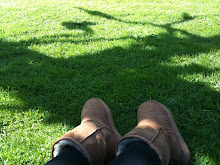
7. My maternal instincts kicked in 2 months ago when the cutest baby sat on my lap. Her name was Gaby, and she was wearing BABY UGGS. How adorable is that?! Her mum was also wearing uggs, which made it even more cute.
____________________________
I'm not sure who's already been tagged, so I tag anyone who hasn't done it yet.
(Wanted to add pics to the post but for some reason I can't :(...)
1. I love writing a post at night and then waking up the next morning to comments. I really enjoy hearing what everyone has to say and knowing that people actually read my blog :)
2. I love carrot cake more than anything else in the world. I have a piece sitting in the fridge right now, and I'm waiting for the perfect time to eat it :D
3. I really hope I end up back in Cairo one day, insha'Allah. I've really fallen for it, and I don't think Holland is the place for me (as beautiful as it is when it snows).
4. Sometimes it is really hard to be a Muslim. I feel pressure coming from some non-Muslims, and pressure from many Muslims. It's a constant battle to defend your views and ideals and sometimes I really doubt myself.
5. I'm scared I'll never find best friends like the ones I had in Cairo.
6. I miss my mum and my sister, and how we used to go Starbucks every weekend to just talk about nothing.
7. My maternal instincts kicked in 2 months ago when the cutest baby sat on my lap. Her name was Gaby, and she was wearing BABY UGGS. How adorable is that?! Her mum was also wearing uggs, which made it even more cute.
____________________________
I'm not sure who's already been tagged, so I tag anyone who hasn't done it yet.
(Wanted to add pics to the post but for some reason I can't :(...)
Sunday, January 31, 2010
Amina Wadud on the Hijab

"If you think the difference between heaven and hell is 45 inches of material, boy will you be surprised."
I've just finished reading Amina Wadud's book "Inside the Gender Jihad". I've always been very impressed with her writing - she is eloquent and writes beautifully, but also commands a lot of respect. She is very (I mean very) well-learned and is really one of the top Western Islamic intellectuals around today.
She wears hijab, so I was interested to see how she came to that decision. She is known for her hermeneutic, linguistic, and contextual analyses of the Qur'an and Sunnah, so I wanted to know what her interpretation of the Qur'an and Sunnah on hijab are.
She writes in the book that she does not see the hijab as an Islamic obligation. "I do not consider it a religious obligation, nor do I ascribe to it any religious significance or moral value per se. It is certainly not the penultimate denotation of modesty, as mandated by the Qur'an, "the best dress is the dress of taqwa."
"Over the past several decades, the hijab has been given disproportionate symbolic significance both within and without Muslim communities. Like a sixth pillar, we cannot discuss Islam and gender without discussing the hijab. While overloaded with multiple meanings, it is often the single marker used to determine community approval or disapproval. Although sometimes random and coincidental, it is also burdened with different levels of volition by Muslim women."
She makes a very valid point: hijab does not necessarily provide a woman with respect or protection. "Those who reduce women to their sexuality will continue to do so. In reality the hijab of coercion and the hijab of choice look the same."
"If a man respected a woman as an equal human being and not as an object of his sexual fantasies, then even a naked woman should be safe from male abuse." I think this is a great point - there is NO excuse for a man to disrespect a woman, no matter what she is wearing. And a good man will respect a woman whether she is veiled or not - the veil is not necessarily going to make a difference, and if it does, then he isn't the best of men.
"When a Serbian soldier in the rape camps can rip a two-year-old girl's body apart by raping her, it is obviously naive to assume that any amount of head-covering would have made any difference or created any real change in deep-seated male aberrations."
Wadud also discusses the fact that because she wears hijab, some women avoid her because they assume the hijab means silence and conformity. Similarly, some women assume she is more religious than non-veiled women, something she also criticizes.
Finally, she writes, "Dubbing it the sixth pillar only shows its ability to divert attention from the issue of substance regarding modesty and relations between the sexes, like unrestricted male libido. The hijab is also a significant marker for the community approval or disapproval. The paradox of my choice and devotion to wearing hijab without considering it obligatory means a significant duality of some strategic consideration for my various roles in the gender jihad."
Her arguments are interesting because she is not one of those scholars who sees the hijab as oppressive/looks at it condescendingly - she herself wears it. She is simply pointing out that she does not see it as an obligation and that many Muslim women feel an immense amount of pressure to conform to this dress code, whether they believe in it or not.
I personally find it interesting how any scholar (Wadud, abou el Fadl) who says the hijab is not an obligation gets viciously attacked to the point of ridiculousness. Why is it such a sensitive issue?
_____________________________________
What does everyone think of her arguments?
Subscribe to:
Posts (Atom)